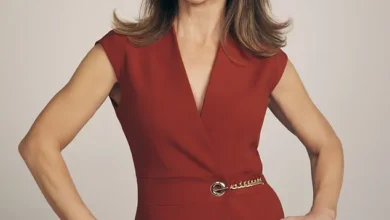
Like So Many Women In Their 50s, Ive Developed Mysterious White Spots On My Arms And Legs – This Is The Dermatologist-approved Fix To Help Clear Your Skin ALICE HART-DAVIS

Looking back, the only surprise is that I hadn’t noticed the white spots sooner.
Then again, like most people, I’m not much given to staring at my shins during a normal working day.
But on holiday last summer there I was, sitting down with a coffee in hand and my feet up on the balcony rail, delighted to see my pallid legs were picking up a bit of colour.
Then I frowned. There was a random scattering of round white patches down the front of my shins. Peering closer, they looked like scars, as if the skin – or at least the colour of it – had been scraped off. What on earth?
my و a و the – تفاصيل مهمة
‘What are these white spots on my shins?’ I asked the internet, which told me it was just idiopathic guttate hypomelanosis, or IGH for short. Nothing to worry about.
Er, what?
It sounds dire but apparently IGH is a common, harmless sign of sun damage which appears as small de-pigmented spots – on any skin type and ethnicity, though they’re prevalent in women and in the fair-skinned – that become obvious with age as we stack up sun exposure over the years.
As to what the medical name stands for, ‘idiopathic’ is a condition that shows up spontaneously, ‘guttate’ means it looks like small round spots or drops, and ‘hypomelanosis’ is easier to guess: it’s a lack of melanin, the pigment that gives skin its colour.
the و is و a – تفاصيل مهمة
Why do IGH spots appear? Sun damage means that melanin doesn’t get evenly transferred to skin cells, hence the white patches.
Last summer Alice Hart-Davis noticed a random scattering of round white patches down the front of her shins. They looked like scars, as if the skin had been scraped off
IGH is a common, harmless sign of sun damage which appears as small de-pigmented spots – on any skin type and ethnicity – that become obvious with age
According to dermatologists, most of us have them by the age of 40, and once you start looking, you start finding them not just on your legs, but everywhere: your arms, your chest, your face… anywhere that has caught the sun repeatedly over the years.
of و the و your – تفاصيل مهمة
I’m 62 and used to sunbathe with dedication before I fell into beauty writing 25 years ago, so here’s the legacy of my misspent youth: IGH all over.
‘Huh! Who knew?’ I thought, and went back to enjoying my holiday, but not before taking photos of the offending spots and posting them on social media, which brought a huge reaction.
‘Is it vitiligo?’ asked one friend. No, that’s an autoimmune condition that causes larger, irregular patches where pigment has vanished.
‘Are you sure it’s not a fungal infection?’ asked another, because her mum had had white spots from that, and got rid of them with an anti-fungal shampoo.
and و not و of – تفاصيل مهمة
Then a brilliant dermatologist from New York state, Dr Heidi Waldorf, leapt into the Instagram conversation and pointed out that the fungal infection in question, tinea versicolor, usually shows up on the shoulders, abdomen and upper arms, not the legs.
It can indeed be despatched with anti-fungal shampoos, creams or pills. And the patches may look faintly scaly. (If you notice paler or darker patches that are new, spreading or itchy, it’s best to get them checked by a doctor to rule this out.)
But what to do about IGH?
Most advice is that there is nothing that can be done. If you nose around online, you’ll find websites which suggest that specialist lasers might be helpful, but when I asked leading laser practitioner Dr Asif Hussein, who is fearless about tackling most pigment-related conditions, he said he wouldn’t treat anyone with this condition.
that و be و or – تفاصيل مهمة
If IGH is really bothering you and you’re off out with bare legs, you could try a cover-up product such as these, which are brilliant for making legs look sleek, even-toned and airbrushed
Why? ‘It’s very unlikely to make any difference,’ he said. ‘When the melanin-producing cells in skin are no longer there, it is not possible to stimulate them into action or achieve re-pigmentation.’
Dr Waldorf, who describes herself as ‘a globe-trotting retired derm diva’ and ‘a second-generation dermatologist for whom tanning was a bigger teen sin than breaking curfew’, held out hope.
She admits they’re tough to treat but they can be improved with fractional laser resurfacing.
to و ‘a و Why? – تفاصيل مهمة
‘I use a thulium laser called the Fraxel 1927nm,’ she said. ‘I find it can improve the surrounding skin by producing some pathways for the melanocytes – the melanin-producing cells – to migrate (from the healthy skin to where they are missing)’.
Medical tattooing suggested someone else a little wildly but, given the number I’ve got, that would a) be agony and b) cost a small fortune. And frankly, I don’t care enough about them.
If IGH is really bothering you and you’re off out with bare legs, you could try a cover-up product such as Margaret Dabbs’ Concealing and Firming Leg Serum (£52 for 200ml, margaretdabbs.co.uk) or Vita Liberata’s Body Blur (£33 for 100ml, vitaliberata.com) – both of which are brilliant for making legs look sleek, even-toned and airbrushed.
In chilly January, of course, the perfect solution is easier – a pair of black tights.
a و and و for – تفاصيل مهمة
Disclaimer: This news article has been republished exactly as it appeared on its original source, without any modification. We do not take any responsibility for its content, which remains solely the responsibility of the original publisher.
Disclaimer: This news article has been republished exactly as it appeared on its original source, without any modification.
We do not take any responsibility for its content, which remains solely the responsibility of the original publisher.
Author: uaetodaynews
Published on: 2026-01-20 00:00:00
Source: uaetodaynews.com