
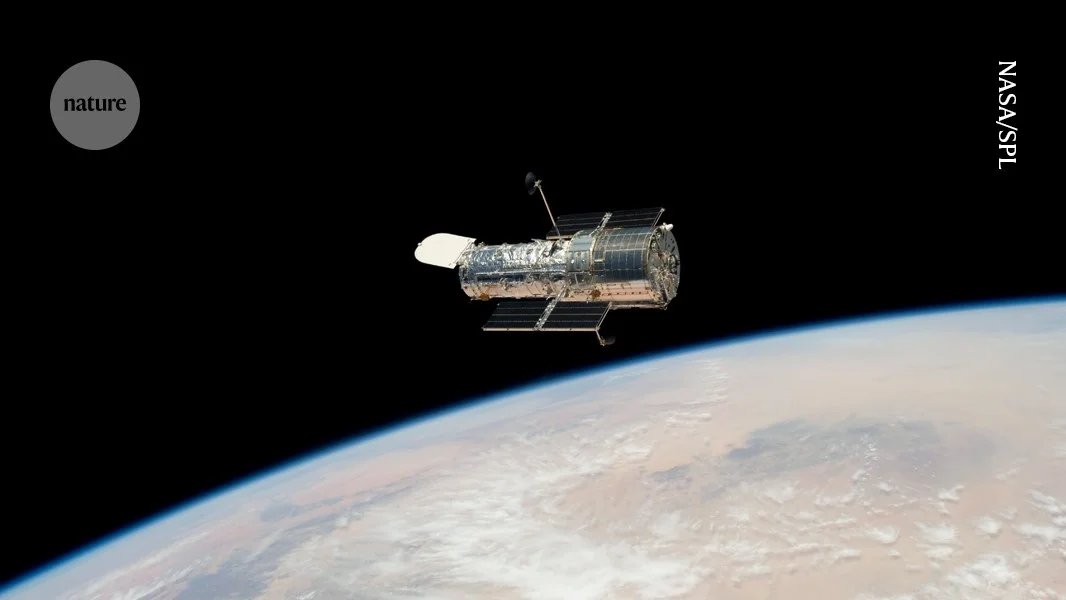
Many of the images taken by the Hubble Space Telescope will be blemished by satellite trails if plans to launch megaconstellations succeed.Credit: NASA/Science Photo Library
Even telescopes far above Earth can’t avoid the contamination caused by commercial satellites.
Blurry streaks of light created by fast-moving artificial satellites are already known to mar images taken by ground-based observatories. Today, researchers report1inNaturethat space-based telescopes will not escape such interference as fleets of private satellites proliferate. The researchers found that in the next decade, satellite trails could taint roughly 96% of the images taken by some space-based telescopes, and a single image could contain as many as 92 streaks.
The findings are “truly frightening”, says Patrick Seitzer, an astronomer at the University of Michigan in Ann Arbor, who was not involved in the work. “This is a very important study for the future of space-based astronomy.”
Tight space
Around 15,000 satellites launched by various companies currently orbit Earth, and several firms plan to launch groups of thousands , forming ‘megaconstellations’ that will be used for telecommunications (see ‘Rocketing upwards’). For example, aerospace company SpaceX plans to grow its existing Starlink fleet to some 34,000 satellites.
Source: Ref. 1
To work out what effects these satellites will have, Alejandro Borlaff, an astrophysicist at NASA’s Ames Research Center in Moffett Field, California, and his team conducted computer simulations of the view from four low-Earth-orbit telescopes, which either currently occupy space or are soon planned to. They include the iconic Hubble Space Telescope; NASA’s SPHEREx Observatory, which launched in March; China’s Xuntian Space Telescope, set to launch as early as next year; and the European Space Agency’s ARRAKIHS mission, set to launch in 2030.
The researchers simulated roughly 18 months of observations, taking faux space pictures with various numbers of satellites in orbit (see ‘Obstructed vision’). They found that if 560,000 satellites are in orbit — the number that is currently planned for launch — their trails will contaminate from 40% to than 96% of each telescope’s images. And with 1 million satellites in orbit, the number of streaks per image reaches 165 for some observatories.
At that rate, “we will have fewer discoveries, less interesting images and, in general, less knowledge”, says Borlaff. SpaceX did not respond to a request for comment about the effects of its constellation.
The most concerning impact he foresees is that the satellites could easily be confused with Earth-threatening asteroids. “And if your images look like they’re filled with asteroids, it’s very possible that you’ll miss a real one,” Borlaff says. He also worries that satellite streaks might make it difficult to detect rare, fleeting phenomena such as powerful explosions called γ-ray bursts.
Light reflected from telecommunication satellites leaves streaks on a simulated image by ARRAKIHS, an oribiting telescope scheduled to launch in 2030.Credit: NASA Ames/A. S. Borlaff, P. M. Marcum, S. B. Howell
One way around satellite interference might be to take images with a short exposure, says Seitzer. This way, not so many trails will plague each image.
The issue is that telescope cameras will probably need to be designed for this kind of imaging in advance, says Jonathan McDowell, an astrophysicist at the Harvard–Smithsonian Center for Astrophysics in Cambridge, Massachusetts. “This isn’t something you can necessarily do if you’ve already launched your spacecraft and now you’re starting to worry about it.”
Disclaimer: This news article has been republished exactly as it appeared on its original source, without any modification. We do not take any responsibility for its content, which remains solely the responsibility of the original publisher.
Disclaimer: This news article has been republished exactly as it appeared on its original source, without any modification.
We do not take any responsibility for its content, which remains solely the responsibility of the original publisher.
Author: uaetodaynews
Published on: 2025-12-03 18:01:00
Source: uaetodaynews.com